If you haven’t seen the 2011 flick The Big Year, starring Jack Black, Steve Martin, and Owen Wilson as competitive birders, go watch it. The goofy but wholesome storyline is based on real people, and a real competition – and it will expose you to a world that is all too real.
People have been observing birds since time immemorial, and birds are still incredibly important in many North American indigenous cultures. In Western society, bird watching did not reach popularity in the United States until the late 1800s, when conservationists became concerned about the number of birds being hunted for feathers and during the annual Christmas “Side Hunt”. Frank M. Chapman proposed a new tradition on Christmas Day 1900: why not count birds during the holidays, rather than hunt them? The Christmas Bird Count was born.
The ultimate modern competition for birding is called a “Big Year”, where individuals travel across North America (or the globe) to spot as many species as possible within a calendar year. In 1939, the first Big Year in North America was completed by a New York businessman and National Audubon Society board member. Guy Emerson strategically planned business trips for birding, logging 497 species in 1939.
Many champions have reigned over the years, and perhaps the most famous record-breaking competition was that of Sandy Komito, Greg Miller, and Al Levitan, who are the inspiration for the characters in The Big Year. Komito beat the standing record with 748 species in 1998.
Just like the bird hunters of Christmas Day, it took us longer than it should have to realize the impact the Big Year was having on the world around us. Instead of piles of dead birds on the ground, it was pounds of carbon dioxide in the atmosphere. Besides, pinballing back and forth across the country on flight after flight is prohibitively expensive. It’s time for a new evolution of birding competition.
Enter the Green Big Year. First started in 2006 in Montreal, Quebec, this version of the Big Year is still gaining popularity around the world. 500 birders joined in the initial year, and two conservationists issued the challenge to the state of Wisconsin in 2010. In 2023, the Wisconsin winner saw 205 bird species with 630 miles of biking.
Green birding relies on human-powered transportation, making it carbon neutral. The only rule is each birding trip must start and end from a home base, usually your place of residence.
From my home in Madison, this means that I am within a 7 mile bike ride of numerous parks, habitats, and “birding hotspots”, most of which can be accessed by city bike paths. It’s a Green Big Year paradise.
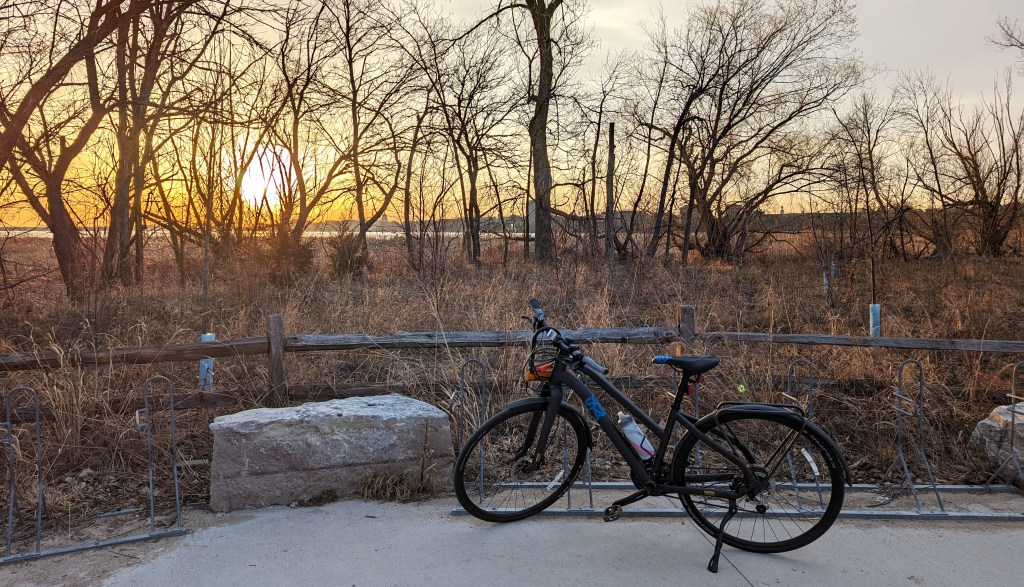
Not only is a Green Big Year more environmentally conscious, it’s also accessible. You can participate in a Green Big Year no matter where you live. You don’t need a car, a bike, a spotting scope, or even binoculars or a smart phone. All you need is a field guide from your local library, a pencil and paper to track your bird list, and the motivation to walk around your neighborhood and see what you’ve been missing.
I’m not setting out to win the Wisconsin Green Big Year, but I do have a goal: 150 bird species in 2024. As of this writing, I’m at 56 bird species, 13 miles of walking, and 68 miles of biking, much of which I have achieved since the beginning of March. Spring migration is on the horizon and I can hardly wait.
If you’d like to follow along on my year-long adventure, you can see birding updates on my Instagram page, @wigreenbigyear, and my Facebook page, Lindsey’s Green Big Year. I’ll be sharing photos, adventures, conservation stories, and fun bird facts all year long.
It’s time to take flight! Wish me luck.
Lindsey
Birds seen to date: 56
Miles walked: 13
Miles biked: 68
Learn more about the Wisconsin “Big Green Big Year”: https://wsobirds.org/what-we-do/wisconsin-green-birding-challenge
 The Curiosity Chronicles
I now have that movie on my to-watch list!
Love all the history you provided because I didn’t even know this existed. And you are already well on your way to your goal!! Amazing progress! Keep it up!
LikeLiked by 1 person